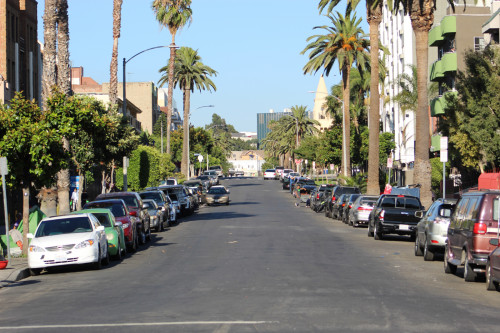
[dropcap size=big]B[/dropcap]efore moving into an apartment building with a garage, Koreatown resident Kate Willis paid over $1,000 in parking tickets in one year. Some were for street cleaning, but most were for parking past one hour, which was the only available option on their street.
“For a while, we had a permit for a lot on Wilshire but then couldn’t get it anymore because you had to wait in line for 3 to 4 hours at 6 AM every month to get it,” she says. Even if residents make it to the front with their cash in hand, they are not guaranteed a night or day pass due to limited supply. Then one month later, the permits expire, and the process starts all over again.
It’s not just a Koreatown thing. In Los Angeles, if you want to keep your belongings—including your vehicle—you need to be rich in time and money.
In reality, there is plenty of parking in Koreatown; they’re just not accessible to the general public.
In the most bustling parts of our city, parking hovers above us as buildings with above-grade horizontal slats of open space for cars. You can find them at Koreatown’s most popular supermarkets and malls, such as Koreatown Plaza, the multi-level MaDang Courtyard on Wilshire and Western, or the new Zion Market that has three sprawling floors of parking for just one story of groceries and appliances. Then at night, when the businesses all close, the spaces lie unoccupied.
In reality, there is plenty of parking in Koreatown; they’re just not accessible to the general public.
Adriane Hoff has one possible idea: remove the privatization of parking for the community. As the Wilshire-Koreatown Neighborhood Council president and a steering committee member of Streets for All, she wants to find the way to get commercial landlords to make their parking available to the public.
“It’s not right that so many structures in the community sit empty at night while many of our neighbors spend upwards of an hour looking for an overnight parking spot,” she says.
How did we get here? For one, it’s an effect of L.A.’s egregious approach to housing. Real estate developers love it in Koreatown; there are many pre-war buildings to flip, and new young professionals love the area for its central location from their respective workplaces (perhaps a media agency in Playa Vista) and the swath of bars and dining. Hell, Koreatown is a playground!
As fun as it may be for real estate groups, building parking is expensive. Developers have often tried to slide the burden on renters by passing on the costs to tenants; nationwide, it’s estimated that 17 percent of rent goes towards the cost of constructing parking spots to meet the minimum for apartment buildings. They also find ways to abuse L.A.’s Transit-Oriented Communities (TOC) Incentive Program. This package came out of Measure JJJ that encourages developers to construct affordable housing near bus and train stations in exchange for density and other development incentives. It’s an initiative that sounds healthy and good by name; developers instead take advantage of it by requesting as many incentives as possible for their project and keeping certain amenities that will keep costs high.
“For example, we keep seeing applicants coming before the PLUM (Planning and Land Use Management) committee that includes way more parking than what the minimum is for a TOC,” says Hoff. Those costs thus become the renters’ burden, the apartment ends up being market rate, the metro stations remain difficult to access, and the city is back to where we’d been.
Aside from the hypocrisy of stressing the importance of sheltering in place then forcing Angelenos to shuffle their cars around, it’s apparent that sweeps are a display of how many L.A.’s elected officials glom onto constituents for every last dollar.
Parking woes are endemic to a larger affordable housing crisis, but they also are austere by design. Street sweeping is an active practice by City Council and the Mayor to catch people off guard. Naturally, it resumed on October 15, in the middle of a pandemic that continues to restrict the movement of thousands of Angelenos.
After Koreatown resident Austin Anderson lost his job due to COVID-19, he had to stop paying for his spot in a nearby garage. He quickly became familiar with the troubles of the alternative.
“Parking on the street adds an extra layer of complexity to my upended day-to-day,” he says.
Since street sweeping resumed, Anderson has to remember to sit in his car for two hours every week to avoid getting ticketed for street sweeping. He’s baffled by the act; it’s not as if the streets were any dirtier in his eyes.
“In the weeks following street sweeping being suspended earlier in 2020, I noticed that the streets didn't really get any dirtier than normal,” he notes. “Other than the pileup of the sheddings off the palm trees, there wasn't any noticeable buildup of dirt or garbage that street sweeping presumably addresses.”
Street sweeps returned in an attempt to recoup losses. A report released by the Department of Transportation last September stated that “Delayed normal parking enforcement is one of the main drivers for the $6 million revenue loss each month.” Aside from the hypocrisy of stressing the importance of sheltering in place then forcing Angelenos to shuffle their cars around, it’s apparent that sweeps are a display of how many L.A.’s elected officials glom onto constituents for every last dollar.
Car owner or not, we all have a stake in this classist nightmare.
From enforcement to street sweeps, parking fines—as a penalty for non-compliance—exist only for those already struggling to get by. The wealthy don’t park on the streets, and even if they did, they’ll always have the time and money to show up and pay a fine. They’re not who the City is after. Upholding tricky street parking rules targets the poor and the working class because they are the people who can’t pay off a citation, let alone compounding ones.
The horrors of Koreatown parking, by way of unaffordable housing, are those shared throughout the city. Consider how many of our own neighbors and friends have their own gripes about Hollywood, Downtown, Inglewood, and West Los Angeles. Beyond the people we know with roofs over their heads, there are still others who endure the nightmare of searching for safe places to sleep in their cars at night (which the City Council has also criminalized). L.A. parking is terrible because many city officials haven’t yet come to their senses about what it means to protect the people who are not wealthy.
It often feels like a race against the clock: The usual suspects are building high-rises at a steady pace, arguably changing a neighborhood’s look and livability. But pushing back on towering development also means fighting for fair use of our surface streets. Car owner or not, we all have a stake in this classist nightmare.