Welcome to our L.A. in the 90s Week, presented by Tecate, the official beer of L.A. TACO. Each day this week, we will bring you features and photo essays celebrating the best of L.A.’s 90s history.
[dropcap size=big]I[/dropcap]n the late 90s, I was a chamaco living in Compton and the thing I looked forward to every day was visiting the candy houses on my way to school.
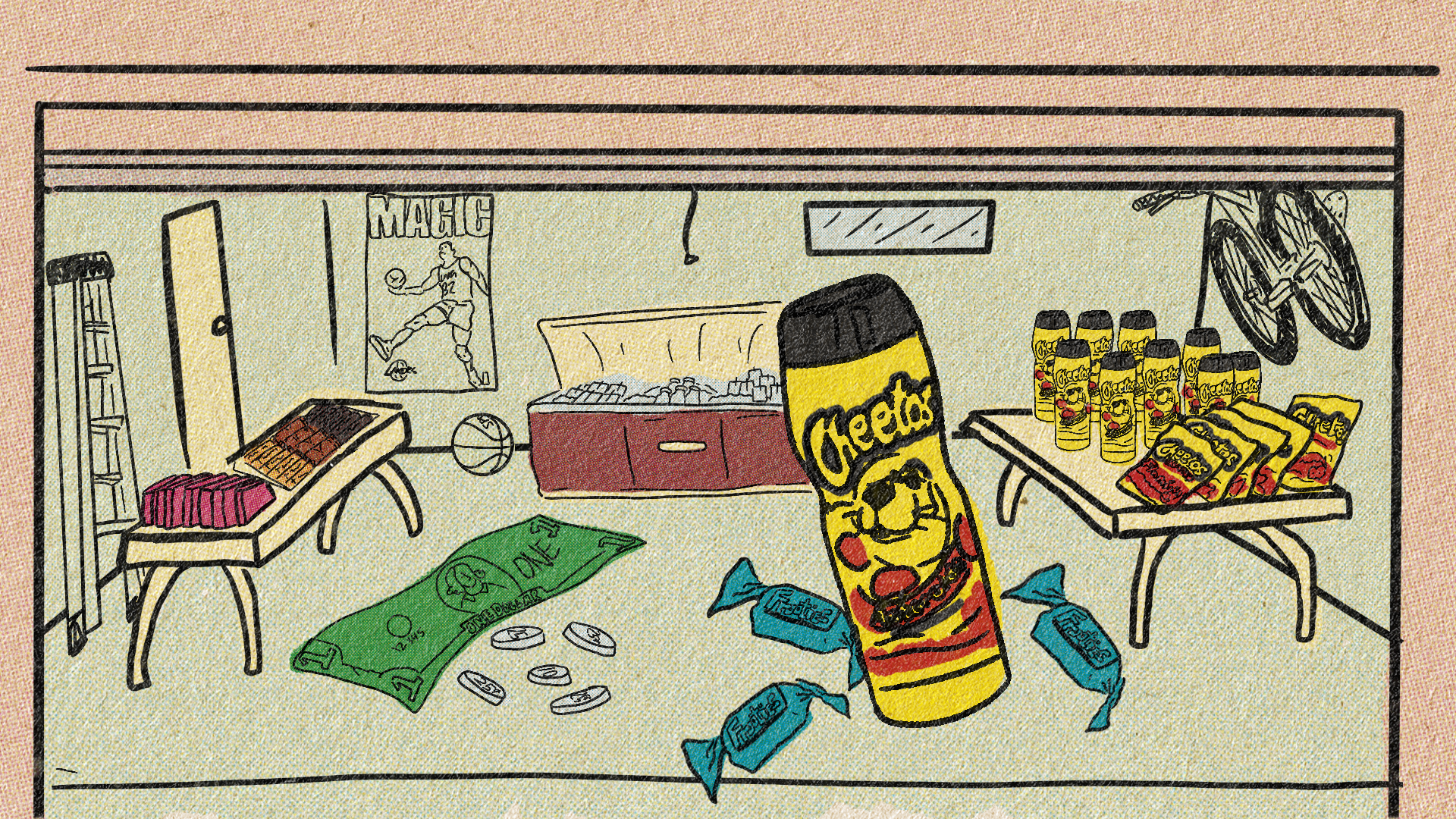
On my walk to elementary school, my cousin explained that there was a place we could stop at to get snacks. In my head, I thought it was a liquor store but we were going down our usual path to school. Soon enough, we were standing in front of someone’s garage that was lined with all the snacks I could imagine. Snack-size bags of chips, little baggies filled with sour belts, an assortment of chocolates and candies, imported tamarindo candy from Mexico and a fridge with plastic bottles of punch and Capri Suns. You could order chili cheese fritos where they’d cut open the bag of chips and fill it with molten cheese and chili.
Think of a candy house like an ice cream truck but instead of being on wheels it was inside someone’s living room, garage, or even someone’s apartment. Except there’s no loop of whimsical music with someone saying “hello” every 10 seconds. Shit, there weren't even any advertisements. They operated almost entirely on word of mouth from the community. No sign posted beckoning people to roll through. You had to know someone who had already been to put you on.
Standing in front of that garage, I felt like I was at the hood version of the Willy Wonka factory.
This revelation of a candy pit-stop before school made me look forward to going to school. I’d wake up early just to ensure I had time to pay a visit. I’d ask my mom or my grandma for any money they could offer me. When that source of revenue dried up, I started checking for loose change in the couch, constantly searching for that dime or quarter that rolled out of an adult pocket. With a quarter, I could get a bag of chips, with a dime I could get some candy, usually Frooties or sour belts. And when I was a high roller with a whole dollar, I started buying snacks for my cousins. Like I had hit a hot streak at a casino and drinks were on me.
Rolling up to school with a bag of chips in elementary school made you The Man. Kids who you thought you’d never hear from, suddenly paid tribute in the form of a compliment just to reach their hands in your precious chip bag. A tug-and-pull act that I was a part of too, saying anything to convince kids to give me some of those sweet sweet chips.
“There was one next to my elementary school,” says Santiago Cruz, lifelong Lynwood resident. “It was a few houses down the street, and they had it set up in the garage. It was cool because they’d just have [snacks] out on tables and a bunch of kids waiting in the driveway. Back in the day, shit was way cheaper. You could get a Snickers bar for like 50 cents.”
Candy houses were a middleman for locals to get junk food and snacks. But they were more than that, they were a social place for kids to meet and bond over Hot Cheetos. They were a way to get to know the neighborhood. The garage in Compton was my first, but it certainly wasn’t my last. I kept going to them even when I was in college.
“I met my childhood best friend at the [candy house],” says Cristian Moreida, who used to live next door to a candy house in Lynwood. “After a game of sideline pop football with the Samoans homies or a skating sesh with the neighborhood roqueros the candy house always came in clutch. Go-to snacks for me were the strawberry sour belts. They were 5 cents each, so with a quarter I was set. To quench the thirst, the 50 cent barrel juices. Damn, that’s some deep nostalgia.” In the summer they sold fireworks and for the old folks single Marlboro reds and Newports. Always hustling.
Andres Hernandez, Lynwood resident for over 27 years, remembers it differently. When I asked him if candy houses were a place to meet people he laughed and said “nope.” He lived in a part of town where it wasn’t as friendly. But he’s a candy house veteran, “One was a garage, a house, and an apartment,” he says, “[I’d] usually get Hot Cheetos and sodas.”
Other candy houses actually required you to go into people’s houses. You’d knock and they’d let you in and you could see racks of candies, open boxes of variety pack chips, sometimes there was a small fridge with chilled drinks. You tell them what you’re looking for and they’d set you up. Or you’d go with your friends and you each pick out your own snack combination. The local commerce of a candy house was a service to the community. A cheap way for kids to entertain themselves without having to walk to a liquor store.
“Some lady down the street from Lincoln Elementary sold out of her garage,” says Lynwood resident Miguel De La Rosa. “She had an assortment of everything, but the main thing my mom and I would go for was the mangoneadas and the chisme.”
Sadly, candy houses as a practice are a distant memory that only live on in the minds of those lucky folks who experienced it. There’s no IG page dedicated to preserving this cultural phenomena. It was just a moment in time and it’s passed. There is no candy house support group or union. In the year of a pandemic, the idea of a candy house seems insane. Entering a potential stranger's house, not a shred of fear, just to get a bag of Doritos. But they were something to look forward to in the midst of the chaotic time of the 90s in Lynwood and Compton.