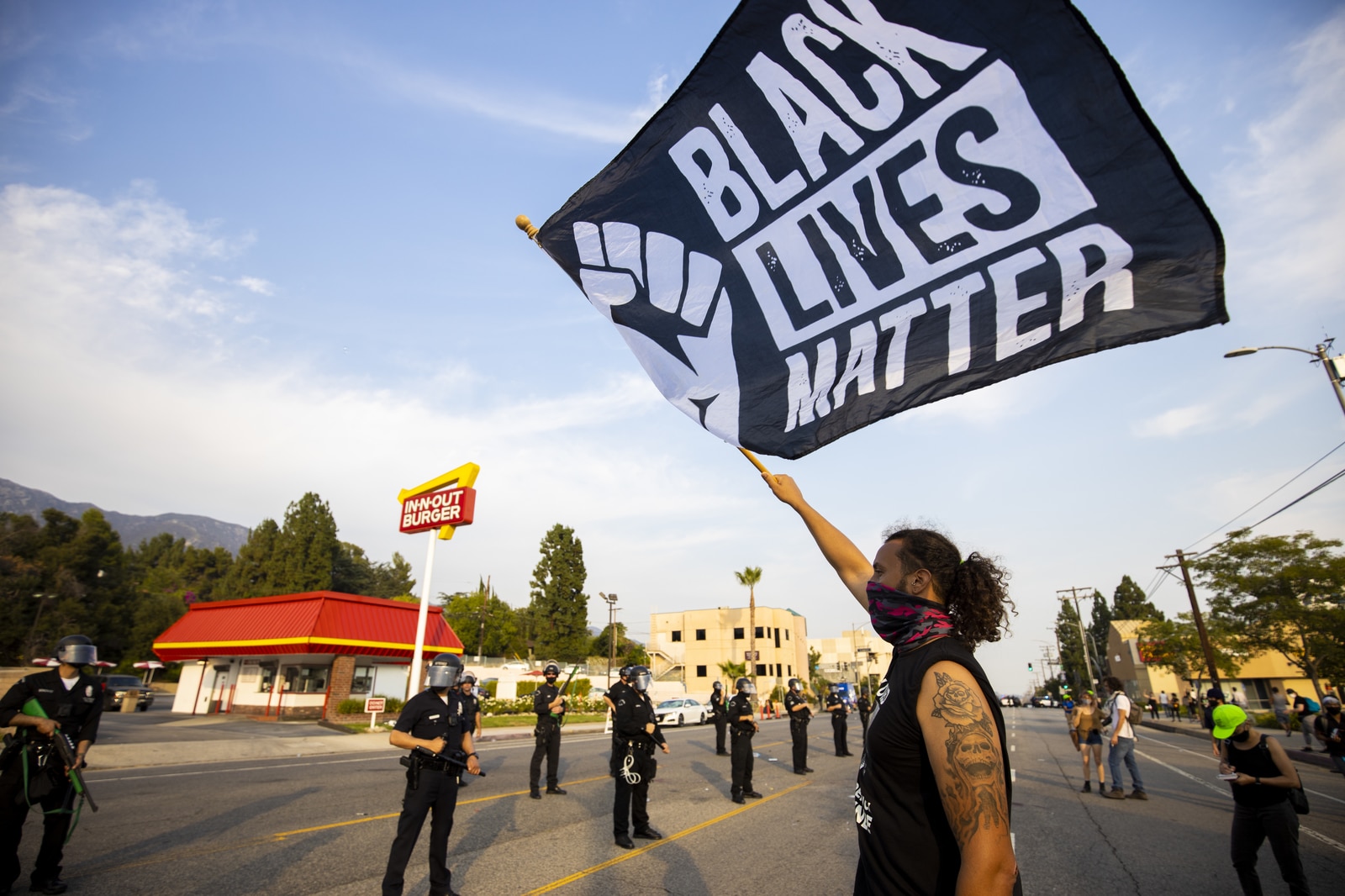
Hundreds of emails from last year show that the Los Angeles Police Department (LAPD) worked with Dataminr, a controversial social media surveillance company, to monitor protesters’ and journalists’ social media accounts during the civil uprisings following the murder of George Floyd. The public records conflict with an earlier statement from the department claiming that they didn’t use the system during the Black Lives Matter lead protests.
Utilized by governments, law enforcement agencies, and even newsrooms, Dataminr’s products are intended to monitor “high impact” events and “emerging risks.” On their website, they boast about identifying a gas explosion in Manhattan and the Orlando, Florida mass shooting at Pulse nightclub, minutes ahead of major news coverage.
Backed by a contract with Twitter that gives them exclusive access to tweets directly after they’re published (commonly known as the Twitter firehose), and a team of analysts that monitor other social media platforms, Dataminr compiles public information in realtime and sells it to back their clients.
Last summer, the LAPD told The Intercept that they conducted a trial with Dataminr but chose not to enter into a contract with the company. They also denied that they used Dataminr in connection with the early BLM protests following the murder of George Floyd in May and June.
However, emails reviewed by L.A. TACO prove that the department was forwarded dozens of Tweets, Snaps, Facebook posts, and other social media regarding the protests.
In one example, a Dataminr alert included an early morning Tweet from 5/30/20 reading, “SHOTS FIRED IN DTLA SHOTS FIRED !!!!!” Three minutes later, it was included in one of Dataminr’s “First Alerts,” the brief updates that they send clients, and a minute later sent to LAPD Officer Hector Guzman, the Officer-In-Charge of the Strategic Communications Unit.
In another, a Dataminr alert includes a Tweet from the reporter of this story while he was on the ground covering a BLM organized protest in the Fairfax area on May 30. “Protestors have lit another LAPD patrol car on fire. This was shot inside a local family business on 3rd,” our reporter tweeted at 3:31 PM. Three minutes later, it was included in one of the company’s First Alerts. Minutes later, the Tweet landed in the inbox of Matthew Rejis, an officer with the LAPD Strategic Communications Unit.
In addition to providing usernames to their clients, they also include when the account was created, Twitter bios, and a tally of followers. In the tweet from our reporter, they included an approximate address that was only one block away from their actual location.
In addition to receiving tips about events happening in Los Angeles, the LAPD also received information about protests occurring in other cities across the country and abroad, including Oakland, Denver, Seattle, Atlanta, Charlotte, Portland, Chicago, Brooklyn, Minneapolis, and even London; as protests escalated during the first weekend after George Floyd was murdered on camera.
In some cases, Dataminr notified law enforcement about protests happening in real time. In other instances, they tipped them off about potential protests before they happened. In a late-night First Alert sent to Joshua Rubenstein, an LAPD spokesperson at the time, Dataminr included an excerpt from a public message board that teased a possible protest targeting Mayor Eric Garcetti’s residence according to an email reviewed by L.A. TACO. “His house seems like a good place to take the protest to next. He is declaring war on the most vulnerable portion of the population,” the May 30 report from Dataminr reads. Days later, on June 2, BLM-LA organized a protest outside of the Mayor’s residence.
Obtained through the California Public Records Act, the request that revealed these findings only sought copies of communications containing the keywords “protest,” “protester,” “demonstration,” “black lives matter,” and/or “BLM.” Emails obtained through the request were sent starting in late May through early November as protests and civil unrest escalated in the wake of the death of George Floyd and during the pandemic.
Hamid Khan, an organizer with the LAPD watchdog group, Stop LAPD Spying Coalition, described LAPD’s partnership with Dataminr as “not surprising” during an interview with L.A. TACO. “This is something that we have kind of been raising and exposing and going after the LAPD for them to stop these activities and for them to dismantle these programs,” said Khan.
According to the longtime organizer, the issue isn’t just the one social media post that might be tracked in the moment of a protest. It’s the more significant ramifications of being included in a police database and exposing other people to surveillance. “That social network analysis and monitoring really become a source or metadata,” Khan said, explaining how one data point can provide information about other contacts. “So for example, if we were monitoring you, you have ten friends, each one of the 10 has another 10...so it becomes this exponential growth, this multiplier effect, where you become a conduit for them to then go after extended social networks and extended relationships, in a sense.”
“The practice is not new,” Khan said.
Emails obtained by the ACLU show that Dataminr first reached out to the LAPD in 2015. “Speaking out against police violence or government overreach shouldn’t land you in a surveillance database,” Nicole A. Ozer, Technology and Civil Liberties Policy Director at the ACLU of California, said in a 2016 essay. “But it can, and it does.”
During the summer of 2016, the ACLU requested records from more than 60 different law enforcement agencies, across the state, including the LAPD. The results of which found that 40% of respondents had acquired social media surveillance tools. That same year, Twitter cut off U.S intelligence agencies access to Dataminr. According to the ACLU, protesters and other experts, social media surveillance companies have a tendency to target communities of color.
Khan admits that some organizers are aware of these tools used by law enforcement and reduce many of their most significant interactions to face-to-face communications. But others are not aware.
“The racist implications of social media surveillance technology are not surprising. We know that when law enforcement gets to conceal the use of surveillance technology, they also get to conceal its misuse. Discriminatory policing that targets communities of color is unacceptable — and secretive, sophisticated surveillance technologies supersize the impact of racial profiling and abuse,” writes Ozer.
The year before the ACLU began looking into this, a rep from Dataminr reached out to the LAPD with an enticing offer:A three month free trial to a service with unfettered access to 500 million Tweets in real-time, proprietary technology that reportedly allowed them to predict the location of 60 percent of Tweets and real-time alerts based on clients interests. “The real-time alerts that we send to users are NOT based on keywords, hashtags or @ handles inputted by user,” an email reads. “Users simply tell us the broad topics they are interested in (i.e., protests, crime, natural disasters) and the geographic area of interest, and Dataminr pushes the most actionable real-time signals to users in a web-based dashboard, email, and/or smartphone notifications.”
Similar to the Citizen app, Dataminr’s software blurs the lines between law enforcement and reporting. According to two company sources that spoke to The Intercept in July 2020, although Dataminr markets itself as an artificial intelligence startup, the company has at times relied primarily on humans to scroll through social media posts. Both Twitter and Dataminr have previously claimed that their work doesn’t qualify as surveillance.
Khan admits that some organizers are aware of these tools used by law enforcement and reduce many of their most significant interactions to face-to-face communications. But others are not aware. “Many of our folks don't know about these kinds of technologies and these kinds of tools that they're using,” Khan said. “Our advice to folks always is like, even in an analogue way, be smart about what you're stating, you know, especially as an organizer. There's a certain obligation and duty to be smart and to have that situational awareness because people are kind of following your lead at times. So in a sense, the responsibility is much higher,” Khan told us.
“Our goal is to create power, not paranoia.”
L.A. TACO reached out to the LAPD and Dataminr for this story on Thursday afternoon but did not hear from them in time to include their comments. We will update this story if we hear back.