Ofelia Esparza’s Dia de los Muertos Altars

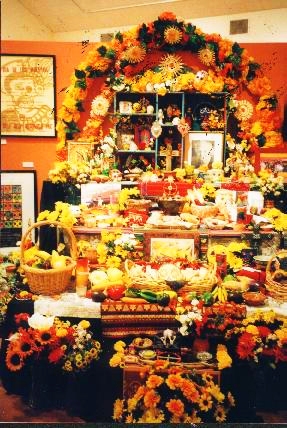
esparza_01-2.jpg

(Photo courtesy of Ofelia Esparza)

Ofelia Esparza is an esteemed artist and noted maker of stunningly beautiful Dia de los Muertos and other traditional altars. You might have caught her work in Puro Muerto or at Self-Help. You can experience Ofelia’s Dia de los Muertos altars at the following over the next few days:
ChimMaya Gallery in East L.A. ~ 5283 E beverly Blvd two blocks
East if Atlantic Blvd.


The Pico House Gallery in Olvera Street: Day of the Dead 
Exhibit ~ October 18- November 19.

               
Community altar at Plaza de La Raza outdoor stage. 
Opening November 1, 4-9PM


Self-Help Graphics upstairs ballroom ~ 3802 corner of Cesar 
Chavez & Gage Ave. E.L.A Day of the Dead Celebration 
November 2, 4-10PM.

               
Altar Photo Installation ~ First Street Studio, E. 1st St, 
near St. Louis Street, in Boyle Heights (L.A)


Additional Altar at Municipal Art Gallery, Barnsdall Park

You should also click on:

TACO! (2 tacos)


Comments (8) to “Ofelia Esparza’s Dia de los Muertos Altars”

  1. Gravatar

    The art show at the Pico House called “Sacred Memory: Honoring the Dead across cultures” is terrific. I highly recommend it.

    http://www.lacity.org/elp/elpdd.htm

  2. Gravatar

    I had the privelege of the viewing at chimaya’s and must say it is most beautiful!

  3. Gravatar

    Ofelias altars are always so beautiful and touching. She puts so much thought into the items she places on her alters. I have only viewed them by photos. Come to the Pacific Northwest and share your talent!

  4. Gravatar

    I´m in Mexico at the moment and there´s a bunch of altars around, I have to say I enjoy the simple ones composed of food items and leaves much more than some of the extravagant altars. I´m taking pics of taco stands by the way, I´ll be sure to share!

  5. Gravatar

    I have to say that I take the cake on this one. Not only have I seen her work, but I have the pleasure of personally meeting her and writing a story of her coming to my school and giving a presentation of her beautiful work for my school news paper, East Los Angeles College Campus News. Her work has taken her to a lot of places and even outside the U.S. like Scottland. What I loved most about meeting and talking to Ofelia was that she still holds true to real traditions of what “Dia De Los Muertos” is all about. Her description of Las Tres Muertes, dying physically, being beried and the worst possible death anyone can go through, the death of being forgotten. In a nutshell, DDLM is to remember and celebrate our ancestors because death is not the end, it’s just the other side of the coin. “Only the good die young, all the evil seem to live forever” – Iron Maiden

  6. Gravatar

    Here is the article I wrote for my schools paper about Esparza…

    Renowned “Dia De Los Muertos” altar maker Ofelia Esparza, who is a former ELAC student, clarified and explained misconceptions about the day’s origins and its true meaning.
    “An altar is a healing experience. It’s a unique way of celebrating the dead and not how they died, but how they lived,” she said.
    “From my experience, most people see altars as sacred pieces,” said Esparza.
    “It’s not a Mexican Halloween just because you see skeletons and skulls. The meaning of an altar is to honor our loved ones and to remember them in a loving way.”
    Esparza, who grew up in East L.A. attributes her passion for her art and altars to her mother.
    “I was greatly influenced by my mother and the people I grew up around when I was a child. My mother had this tradition of making home altars and I became involved in helping her,” said Esparza.
    During those years her mother gave her advice as to why she celebrated “Dia De Los Muertos,” and why she built altars.
    Esparza says that it is the essence of why she does her work “Las Tres Muertes,” the three deaths.
    Esparza said that in life we all go through three stages of death: the day we die, the day we are buried and the day we are forgotten.
    She said that the worst death a person could go through is dying and not being remembered for who they were and how they lived.
    She contributes this to the reason as to why she has continued to build her altars, so she will never forget her family, mother and ancestors.
    As a child, Esparza recalls her mother making altars at home and at the local cemetery with marigold flowers, candles and various pictures of her grandparents and great grandparents.
    Esparza said that these three elements, the marigold flowers, candles and personal items, are vital elements needed for any altar.
    “I got to know my [ancestors] even though I never met them and through the altars they became a part of my life,” said Esparza.
    Over the years, Esparza has had help from her own children in building altars.
    Her sons and daughters help in the construction of the altars, building frames and tables to decorating the altar with flowers, pictures and various decorations.
    One of her daughters, Rosanna Ahrens was responsible for creating the visual presentation used by her mother during her talk at the Edison Center for the Performing Arts on Oct. 10.
    Even though Esparza has been creating altars for a number of years, she didn’t start to get recognition until she started working with Self Help Graphics in 1980.
    At SHG, she began working with founder Sister Karen Bocalerro and other local artists.
    Since then she has been involved with SHG’s annual celebration of “Dia De Los Muertos,” and has created altars dedicated to immigrants who died in September 11, soldiers who have died in the Iraqi war and altars for incarcerated and dead prisoners.
    “SHG opened up many doors for me and as a result I was able to travel to many places and continue making altars,” says Esparza.
    She traveled to Chicago to build an altar for the Mexican American Museum, and to Scotland.
    While in Scotland, she visited a community that through her altar mourned the death of children who died in a bombing.
    Even though people never heard or knew anything about altars and “Dia De Los Muertos,” they embraced and accepted her contribution.
    Syvil Venegas, who is a Chicano Studies instructor, has been hosting Esparza in her Chicano Studies 62 class for the last three years.
    Venegas has her students create personal altars and have been on display in the library for the last couple of years.
    However, this year with the help of Movimiento Estudiantil Chicano(a) de Aztlan club and Vincent Price Gallery’s Director Karen Rapp, they were able to host the event not only for Elans, but also for Roosevelt High School students.
    Ben Gertner, who is an English and Journalism teacher at Roosevelt, brought students to listen to Esparza speak because like Venegas, he is having his students create “Dia De Los Muertos” altars for their class project.
    Esparza will be building an altar again this year at SHG for its annual celebration.

  7. Gravatar

    Thanks Erick! Great story!

  8. Gravatar

    My mother is Ofelia Esparza and she does give great attention to the detail and position of the items in her altars. Everyitem from the fabric and flowers to the articles have meaning. You see a lot of life in the altars and stories told in the altars. They give one inspiration to honor those who have passed on.

Post a Comment
*Required
*Required (Never published)