L.A. TACO is embarking on its biggest mission yet: to create a taco and food guide for every single neighborhood in Los Angeles! Along the way, we will also be releasing brief histories of each neighborhood to understand L.A.'s past and present a little more while celebrating how each and every square inch helps makes our fine city the best in the world.
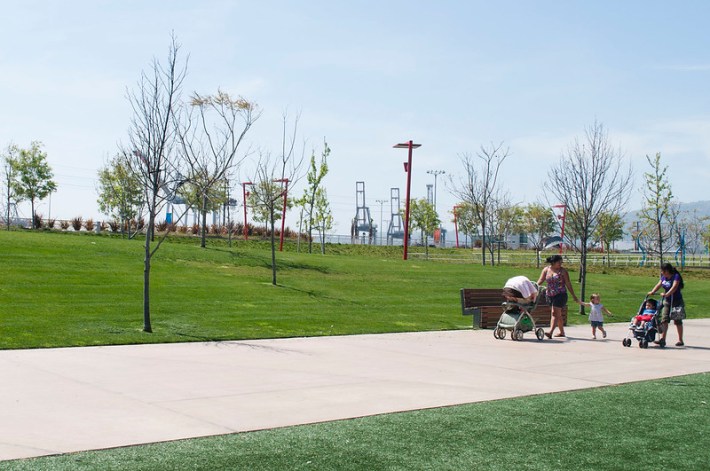
—Wilmington is a port town and, over the last century, has become a significant oil town. Almost 20% of the heavily industrial neighborhood’s 9.14-square miles is occupied by numerous oil refineries. Our country’s third largest oil field, the Wilmington Oil Field, was discovered here in 1932. Sadly, the resulting pollution has taken its toll on local residents, comprised of a Latino majority and a large population of foreign-born individuals. The neighborhood has been the site of numerous refinery-related disasters while health issues have reportedly taken a hard toll on residents of all ages, including a recent rise in deaths from lung disease, heart disease, liver disease, Alzheimer’s Disease, elevated blood pressure, diabetes, and strokes that are high above the average in most communities.
—While artifacts indicate that indigenous people occupied today’s Wilmington area as far back as 7,100 years ago, the region’s modern history stretches back to Juan Rodriguez Cabrillo’s explorations of the California coast in the 16th century and the granting of the 75,000-acre Rancho San Pedro to former soldier Juan Jose Dominguez by the Spanish crown in 1784, for his service in the Portola expedition.
-Dominguez’s grand-nephew inherited the land that would eventually become Wilmington, briefly known as New San Pedro, before selling it to Phineas Banning, an owner of a freight-shipping business and local stagecoach line, in 1858. Born in Wilmington, Delaware, Banning renamed the land and began laying out plans to construct a new, more legitimate harbor for the City of Los Angeles. History remembers Banning by the nickname “Father of the Harbor” for founding what would eventually become one of the world’s busiest ports, as well as for Banning, California, which is named for the entrepreneur.
—Wilmington was ready to defend the South Bay against Confederate invasion during the Civil War, after Banning and first L.A. Mayor Benjamin Wilson gave 60 acres of land to the U.S. government to construct Drum Barracks, or Camp Drum, a garrison intended to protect the growing harbor while increasing Union sympathies, as many recent California residents hailed from the South, bringing their allegiances into question. The infusion of 2,000 to 7,000 troops suddenly made Wilmington more populous than Los Angeles city itself. Today the Drum Barracks is a historic monument that serves as a museum, located just one half-mile from the Banning House, where visitors can see a historic officer’s room and an armory from the era. In the 20th century, Wilmington would contribute to the U.S. military’s efforts in World War II, offering a port of embarkation for soldiers to depart overseas and housing The California Shipbuilding Corporation, responsible for building 467 ships.
-Before the neighborhood was annexed by L.A. in 1909, despite notable local opposition, Wilmington was once much larger in size. In 1870, it was known as San Pedro Township, with a population of 942 people. It comprised present-day Compton, western Long Beach, and acres of an empty mudflat in San Pedro Bay known as Rattlesnake Island, or Isla Raza de Buena Gente. This land would later be incorporated into Terminal Island, a human-made peninsula that was once the epicenter of the tuna production, where a federal prison opened in 1938 and has housed such notorious convicts as Al Capone, Charles Manson, Henry Hill, and LSD pioneers Owsley Stanley and Timothy Leary. It continues to operate as a low-level prison today.
-Six years before USC was founded, Wilson College opened in Wilmington in 1874 to serve as the first co-ed college west of the Mississippi. 112 years later, the first location of hot dog chain Der Wienerschnitzel, later just Wienerschnitzel, was opened on Pacific Coast Highway in Wilmington by a former employee of Taco Bell in 1962.