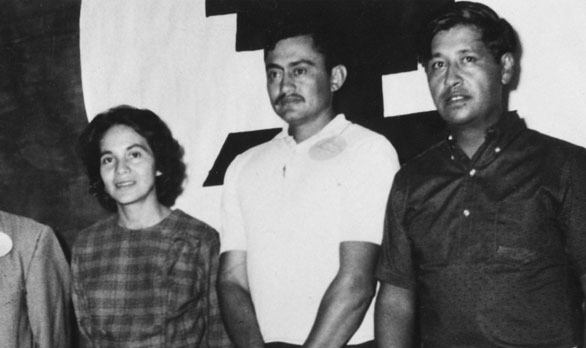
[dropcap size=big]D[/dropcap]olores Huerta and Cesar Chavez came up with the idea for the United Farm Workers in his wife’s kitchen in Boyle Heights, Huerta told a packed ballroom Thursday at Cal State L.A. on the 50th anniversary of the school’s landmark Department of Chicana(o) Studies.
“Cesar lived right here on Folsom and Fickett, right here in Boyle Heights,” Huerta told the overflow crowd atGolden Eagle Ballroom, pointing back literally and figuratively into history.
She could barely be seen behind a large podium, but the 88-year-old Civil Rights icon schooled Los Angeles on the Pueblo's role in the Civil Rights Era. Huerta detailed a timeline of the events leading up to the inception of the movement that would bring national attention to the plight of California farm workers and racism faced by Mexican Americans, and that would catalyze the state’s modern labor movement.
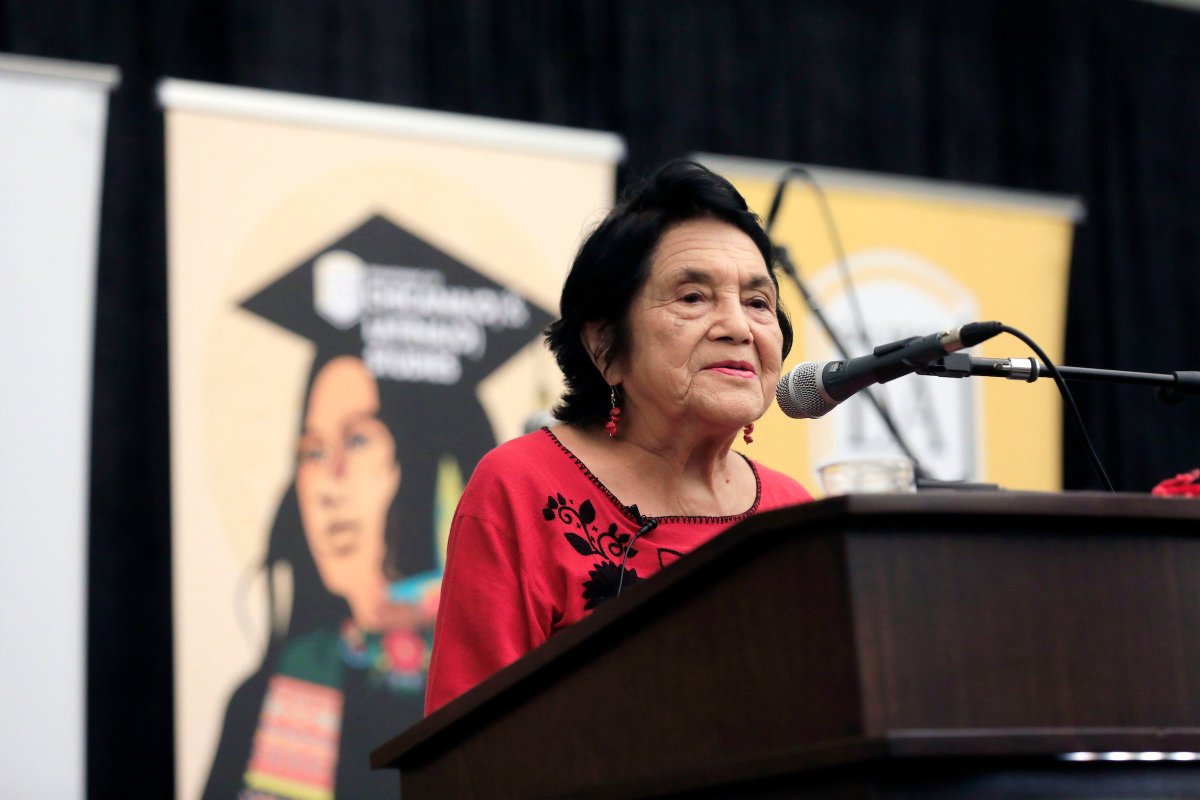
Billed as a special lecture, the event featured a rousing performance by punk legend Alice Bag, backed by an all female Mariachi trio, and an announcement of the soon to be “Dolores Huerta Square” in Boyle Heights. The square at the intersection of First and Chicago is about 10 blocks from where it all began.
“He called me one day. It was a Sunday. And he said, ‘I need to talk to you’,” Huerta recalled. “So I went over to his house and we were there with his wife Helen, at her kitchen table, and he said, ‘We have to start the union. Farm workers will never have a union unless you and I do it.’”
Huerta and Chavez both grew up in farming communities in central California. But they actually met through their work with the Los Angeles based Community Service Organization.
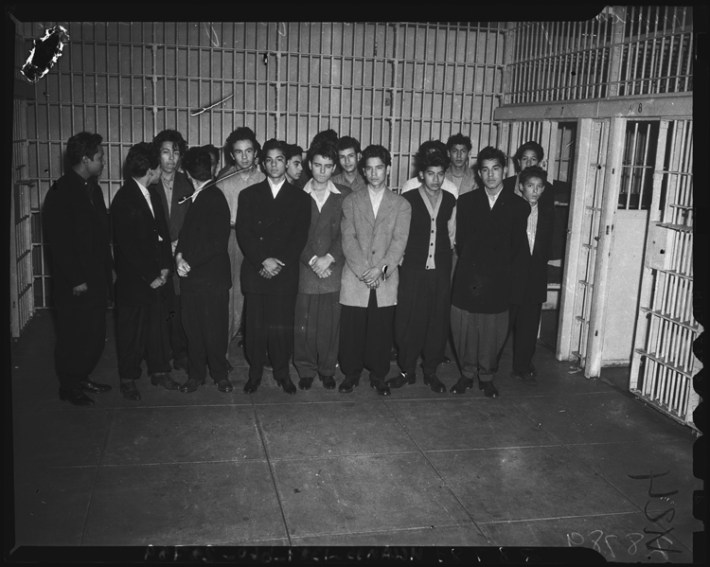
The CSO was a Mexican American community organizers coalition founded by Fred Ross. Ross and Cesar Chavez would eventually help build chapters of the CSO all across the state, including one in Stockton that Huerta led. According to Huerta, the CSO was created in response to the Zoot Suit Riots.
“They called them the Zoot Suit Riots but actually the people who were actually being attacked were many of the young Mexican Americans who used to wear the Zoot Suits,” Huerta explained. “Sailors who were in the Navy during World War II came into East L.A. and started beating up the Mexican kids.”
RELATED: Dolores’ Film Seeks to Re-Think Labor Leader Dolores Huerta — Again
Huerta said the L.A. City Council brought in Ross to deal with the “Mexican problem.” The city reached out to Saul Alinsky, a socialist and frequent target of rightwing vitriol, who is credited as the founder of modern community organizing. Alinsky’s answer was to organize the Chicanos. Ross had made a name for himself organizing a group of Mexican parents in Orange County.
Mendez v. Westminster, was a landmark case decided in 1947 involving the segregation of Mexican American students into remedial schools. The group of five Mexican American families organized by Ross and primarily bankrolled by Gonzalo Mendez won the case that led to desegregation across the state and then Governor Earl Warren signing a bill repealing remaining segregation laws in California. Seven years later, Warren would be Chief Justice in the Supreme Court’s unanimous ruling in Brown vs. Board of Education making racial segregation illegal across the nation.
“[Ross] came into East L.A. and started organizing through a method we still use today, that Cesar and I used to organize the farmworkers,” Huerta explained. “House meetings, meeting in people’s homes and talking about the issues but then reminding them that they have the power to fix their own problems.”
Huerta said the approach paid dividends right away.
“They started building chapters, in Boyle Heights, in Maravilla, and all over East L.A. And then they started registering people to vote.” Once politicians started seeing Chicanos as potential voters, Huerta said they “panicked” and started putting up street lights, sidewalks, and other repairs around East L.A. They even brought in a clinic.
RELATED: When the Jewish Bakers of Boyle Heights Were Radical Socialists Instead of Trump Supporters

[dropcap size=big]T[/dropcap]he CSO then took on the LAPD. “They had this situation where they beat up these young veterans, Chicanos that had come home for Christmas. Police had them there in the Hollenbeck police station, and they beat them all night long. They took turns beating them up.” CSO organized a series of public hearings that ended with some of the officers involved going to prison.
“When I went to a house meeting in Stockton, and [Ross] told me about what they had done in Los Angeles, about how they had sent police to prison for beating up Mexican American kids, I said I want to belong to that organization,” Huerta recalled. “That meeting changed my entire life.”
The meeting with Ross led to her involvement with CSO where she met Cesar Chavez. In 1958, Chavez was appointed national director of CSO. That’s when he moved to Los Angeles. In 1962, in that kitchen in Boyle Heights, they decided to organize the farm workers.
“So if we commemorate that moment, that the birth of the United Farm Workers, the union, the Chicano movement, it’s all here,” she said calmly with a smile. Huerta, a living embodiment of all that history, looked around the room and moments later had the crowd screaming “Los Angeles!”, “Chicano Power!”, and “Si se puede!” like it was 1962 all over again.
RELATED: Major Shift on Police: Cops Will Have to Release Body Camera Footage and Records on Bad Behavior