f Richard Spencer made a rap album that was produced by Kenny Beats, people would probably love it because they would listen to it and go, ‘This is hard.”
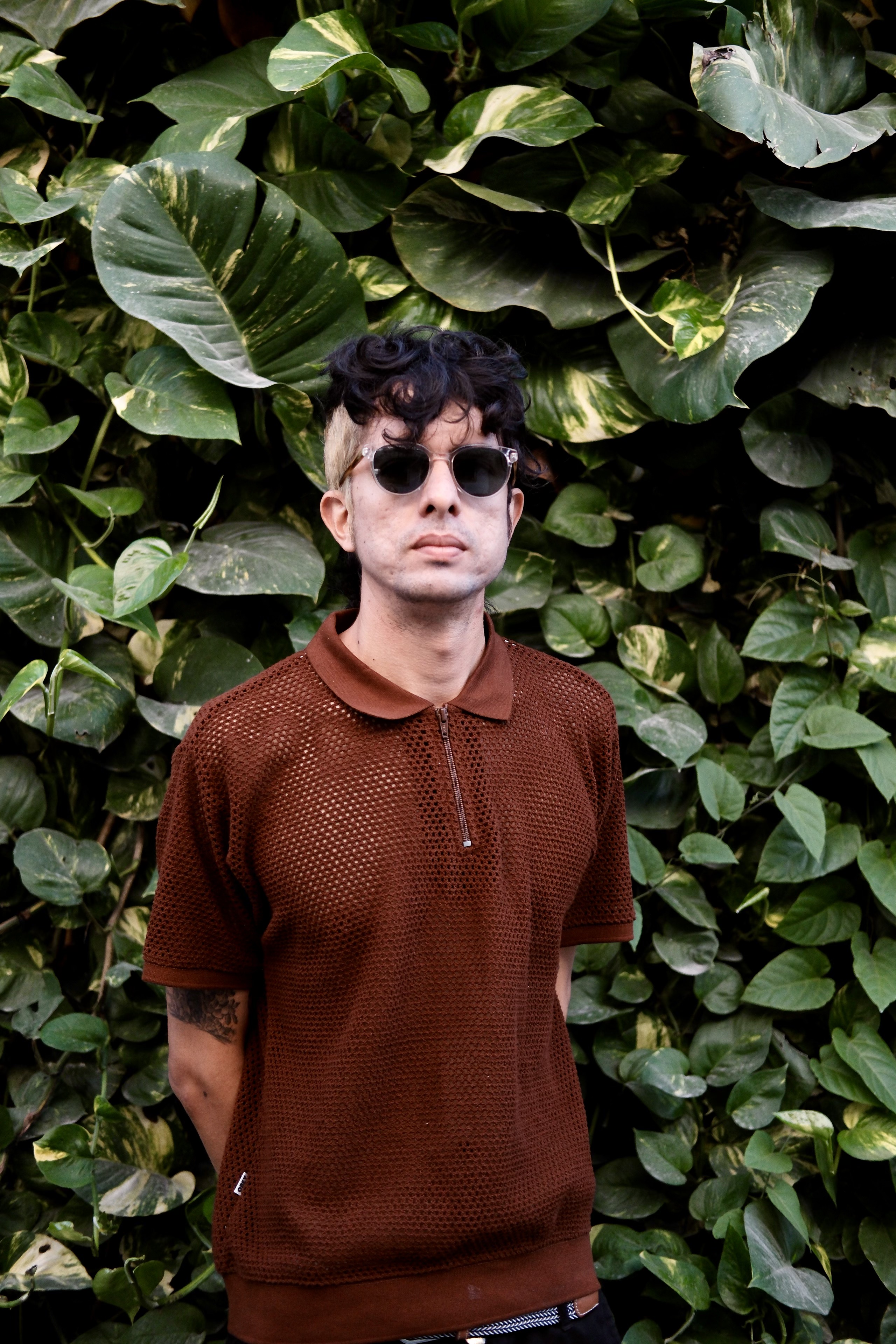
L.A. rapper Rhys Langston said this with a laugh. “I’m not trying to throw Kenny Beats under the bus.”
Nowadays Hollywood and Downtown bars and clubs feel predictable with the thicket of bass-heavy beats and 4-bar loops that culminate in precise drops that slice with the accuracy of an X-acto blade. Everyone at once sways with liquids spilling from unsteady cups. We love this shit, or rather it feels familiar. Like wallpaper, these songs are so inoffensive in texture and volume that they’ve become ambient.
In other words, Langston is getting bored with the current state of mainstream hip-hop. There are a lot of technical elements to it that feel predictable to him. Language Arts Unit is his new avant-garde rap album, here to remind you of a time when parties didn’t feel so thunderously dull.
The latest LP took five years to complete. This was intentional; it worked against the current music industry where artists are expected to churn out singles then course-correct based on algorithmic and audience feedback. “I took time as a middle finger to everything,” Langston said.
Sonically sprawling and experimental, the album first began as rough instrumentals in 2014 then started to crystallize in 2016 when he was deeper in thought about his family history and how it pertained to race, color, and the perception of blackness.
Langston is half-black and Jewish. He grew up all over the city but spent much of his elementary, formative years around Los Feliz when it still cost only $750 a month for a two-bedroom apartment with a sunken courtyard and two entrances (according to his mother). After his parents separated, Langston split his time between his Jewish father’s place in Beverlywood and his black mother’s residence in Windsor Hill and Leimert Park. It was a deliberate decision on his mom’s part to move to the South Central enclave while Langston was still a teenager.
As almost any Angeleno could tell you, identity is difficult to compartmentalize neatly.
“At this point in time I was coming into adult consciousness and I was learning who I was. My mom wanted to move to a predominantly black neighborhood,” he said.
As almost any Angeleno could tell you, identity is difficult to compartmentalize neatly. Langston explores this on his single “Nebbish Frederick Douglass.” Both in its visual and lyrics, the song is quite literal about the juxtaposition between growing up Jewish and black. The poetry within is eccentric; every which way he goes, Langston sidesteps from the learned desire to categorize by race or background:
The nebbish Frederick Douglass feeling peckish
Techno-yiddish scribbled with a pencil
Vestibule, a threshold of lectures
Lectern as he raps all the measures
The dizzying horns that accompany Langston’s verses suggest that the quiet radical thinking that has been happening within his walls is about to blow.
If it sounds a little neurotic, maybe it is. Language Arts Unit is an exercise in verbosity as style and as a result, it tumbles into absurd territories. It is radical thinking with murky pop tendencies; “Poet-Swordsmith of Baldwin Hills-Crenshaw Mall” and “Eyes Dyed In Saturated Retinas” boast smoked out, catchy choruses that would have anyone murmuring them within seconds. Largely produced and mixed on Langston’s own, the album introduces thoughtful melodies that reflect his changing musical tastes. They coexist with his unfettered, nonstop poetry.
“Whether or not times are actually crazier than they ever were, or if we just have more things to remind us of what’s going on, I’m trying to bring a few more deep breaths into the world.”
Though made with patience, Language Arts Unit has an anxious heartbeat running through it. It parallels the urgency to record, archive, and put things onto paper to preserve a memory or feeling. We lose touch with how meaningful this is when we give ourselves to the digital world, uploading our personal moments for monolithic tech companies that compromise our attention span and mental faculties. All the photos, videos, and recordings we share online ultimately are not ours to own. With no proper archival, all of our digitally uploaded “memories” can disappear the moment any of these companies shut down their storage spaces.
To counter this depressing byproduct of our tech-accelerated world, Langston wrote a book to accompany his LP. It contains his lyrics and a reflective essay on blackness and identity to contextualize the project. In a world charged by attention economics, creating a book is defiant because it is thoughtful.
Language Arts Unit is Langston’s forward motion to marking his legacy. One day he can see his projects being archived in institutions like the Library Of Congress. “They are still the ones that have the storage space to archive, or they have buildings to hold copies of books or vinyl at the right temperature,” he explained. “I want to take [my projects] to those places and really breakthrough and, honestly, appropriate their money.”
Langston would tell you to step outside to recalibrate against all those very things that leave us hyperventilating when we’re online.
The deliberately contained energy throughout the Language Arts Unit feels focused because everything else around us doesn’t. It’s why its anxiety feels palpable and electric. “If there’s any metaphysical energy to what’s going on here, then there’s the disruption through patience that is embedded in this project,” explained Langston. “Whether or not times are actually crazier than they ever were, or if we just have more things to remind us of what’s going on, I’m trying to bring a few more deep breaths into the world.”
Langston would tell you to step outside to recalibrate against all those very things that leave us hyperventilating when we’re online. Leimert Park, a longtime hub and creative locus for black artists is exceptional at preserving collective memory because they have active participants pumping love and life into the neighborhood regularly. Langston lived there until 2017, but he still considers himself a community member.
“There’s a pulse [in Leimert Park]. It’s consecrated, hallowed ground,” he noted.
It’s where legacy is understood, the kind under which Langston was nurtured. Art rap had been incubating under the attentive eyes and ears of Leimert Park’s community from the time that Ben Caldwell began KAOS Network in 1990. Hip-hop workshop and showcase Project Blowed then ushered in an era of rappers with new ideas about aesthetics and songwriting. It welcomed “Busdriver” and “Open Mike Eagle” with their complex and poetic experimentation, which brought avant-garde culture into the city with the brazenness of a left turn at a congested L.A. intersection. Bananas, the latest iteration of artist showcases, also became a time-honored ground for emerging musicians; artists like Anderson .Paak, Casey Veggies, and Dom Kennedy have come through to perform. It is also where Rhys Langston began building upon his work.
Leimert Park’s arts scene feels communal and restorative, unbothered by all that exists online to drive preconceived notions about people and places we do not know. Civic engagement keeps together a city when the online social networks feel like a wildfire. In Rhys Langston’s Leimert Park, residents know a thing or two about staying and giving. They engender new perspectives in spaces where the context hasn’t fled the rooms.
Los Angeles loves and honors its homegrown legacies. If no one is recognizing your own legacy, simply do it yourself. “I think it’s important to self-define,” Langston said. “For me, mythology is important because things are just too normal a lot of the time. Things are just too safe.”
The music doesn’t seem like it’ll end at Language Arts Unit. Rhys Langston has bigger plans for his legacy. Mythical L.A. lore, and his second to the last song on the album featuring Serengeti, tells us that he could rap forever.