Last Friday, during its first meeting of 2026, the Los Angeles City Council unanimously advanced a proposal that could change the way the Los Angeles Police Department (LAPD) responds to protests.
The proposal from Councilmember Hugo Soto-Martinez requests that the LAPD and various other city departments work with labor unions and immigrants’ rights organizations to come up with best practices and trainings for “marshals or stewards” that could be deployed at protests in place of cops, and instructs the LAPD to immediately incorporate a “graded response” model at protests, similar to other major cities such as New York and Boston.
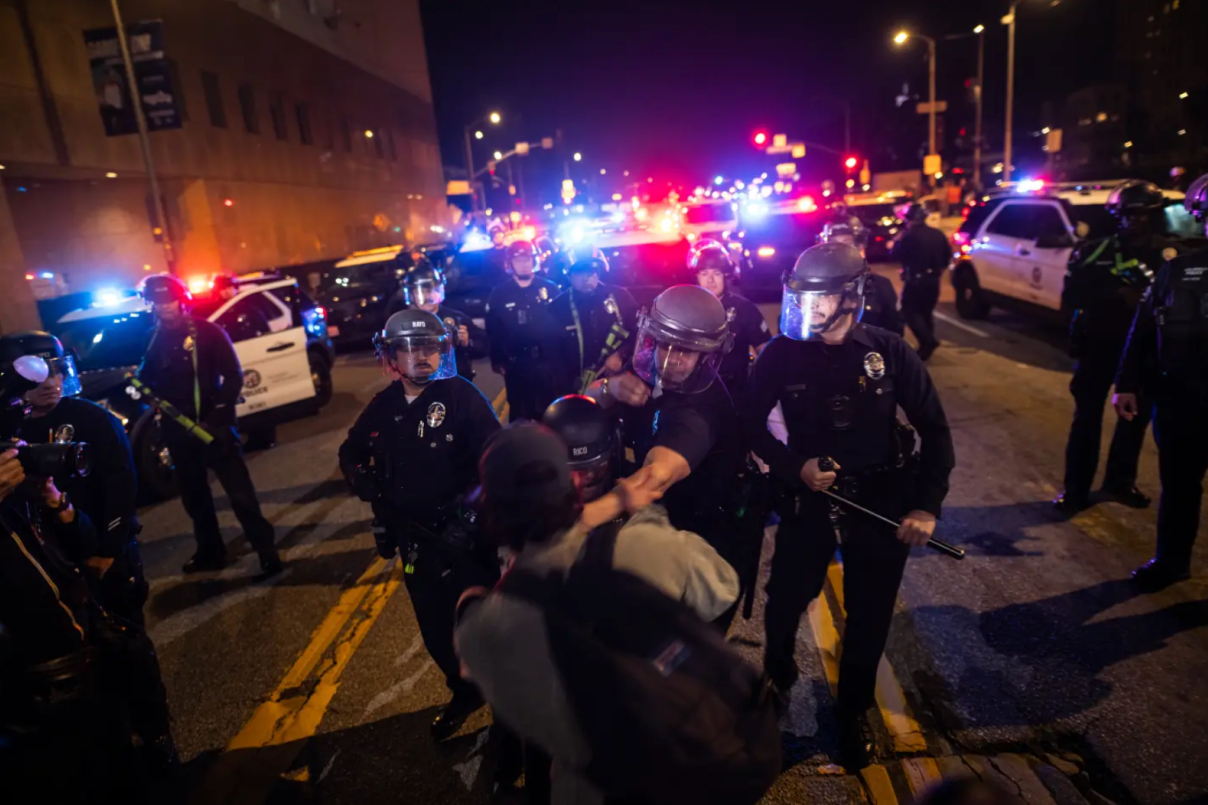
The “graded response” model calls for police officers in regular uniforms to be deployed at protests before sending in heavily-armed officers in riot gear and specialized units such as Special Weapons and Tactics (SWAT), if needed. The approach relies heavily on communication between protesters and police.
Soto-Martinez’s motion cites a 2020 Harry Frank Guggenheim Foundation study by a group of researchers that interviewed officers from over a dozen police agencies around the country to identify “best practices to increase community safety while also safeguarding people’s constitutional rights.”
The researchers found that the use of "militarized police” at protests often leads to more conflict between police and demonstrators.
“When police are viewed as exerting their authority in an oppressive way, conflict becomes more likely,” the researchers concluded. “If the goal is genuinely to keep the peace and prevent conflict, dressing officers in riot gear and shutting down dialogue between protesters and police is likely to fail.”
“When communication happens upfront, we allow for people to control the situation and keep themselves safe,” Soto-Martinez said during Friday’s meeting. “We see fewer flash points, fewer confrontations, and fewer people getting hurt. Again, this is really about letting folks protect themselves.”
The Council District 13 representative recalled attending a protest over the summer, following the arrest of union leader David Huerta.
“I attended that really massive march that was led by labor at Grand Park. And I remember noticing how few police officers were within eyesight of crowds of literally thousands of people,” Councilmember Soto-Martinez told his colleagues.
The council member attributed the minimal police presence to the fact that protest organizers had volunteer medics on call and they “built clear structures of communication.”
“And I want to be clear, this isn't about asking permission about how we protest,” Soto-Martinez emphasized. “It’s simply about communicating with LAPD and our city partners so there are no surprises.”
The “graded-response” motion is the most recent City Council proposal to limit the LAPD’s use of less-lethals and heavy-handed tactics at protests, to be considered by the full City Council.
During the final City Council meeting of 2025, the 15-member governing body unanimously advanced another proposal that could create a city-wide ordinance that would limit the LAPD’s use of “military equipment” at protests.
A week prior to that, the City Council rejected a similar motion that could have removed tear gas and 40mm foam launchers from the LAPD’s extensive arsenal of so-called “military equipment.”
The three proposals came in response to the LAPD’s widely condemned handling of anti-ICE and anti-Trump protests over the summer, during which dozens of protesters, innocent bystanders, and journalists were brutally injured by police.
Police department officials have mostly defended their officers' use of “less-lethal” foam bullets, tear gas, and other munitions, claiming that they’re only used when officers or other members of the public's physical safety is at risk. And they claim that they don’t target journalists.
The “graded response” proposal is arguably the most ambiguous of the three motions to curb the LAPD’s use of “less-lethals.” And it’s possible it will face some legal hurdles and pushback in the future since the Los Angeles City Council has limited oversight of the LAPD and generally does not have the authority to establish or change LAPD policy. That power is held by the Los Angeles Board of Police Commissioners, a civilian executive board of the LAPD.
“As far as I can tell from looking at the agendas of our oversight body, which is the police commission, they have not been engaged with these issues in great depth either,” Councilmember Nithya Raman said during Friday’s meeting.
Raman described Soto-Martinez’s proposal as “ambitious.”
“When motions come forward in this body, often they take years for them to move through our creaking system,” Raman said during Friday’s meeting before the council voted on the motion.
“And I hope because this moment is calling for change that the public safety committee, council president office, the mayor and others who have direct oversight of the [LAPD] will help move the ideas that are embedded in this motion forward more quickly and that we can actually see real change on the ground,” Raman continued.
Activists who spoke to L.A. TACO had mixed views on the “graded response” model.
Some said that they welcome the opportunity to improve communications between LAPD and protesters, but they have questions about how the “graded response” model will be implemented and doubts about whether it will make a significant difference on the ground.
Others said that the idea reminded them of previous proposals—such as the adoption of body cameras—that were branded as “reforms” but ultimately resulted in minimal systemic change when it came to holding police accountable.
Several other people said that they weren't open to communicating with police at all.
“With LAPD violence ongoing, we of course want less police, particularly those ready to very obviously get violent,” said Adam Smith, an organizer with the Skid Row-based Los Angeles Community Action Network (LACAN). “However, we must too be cautious when we think about police reforms in relation to substantive and progressive change.”
“Most often, LAPD reforms end up expanding the already bloated budget of the LAPD, expanding their capacity for violence, while LAPD and politicians alike speak of progress,” he continued.
Zxaye Jah-Reign, a Black organizer who was heavily involved in the anti-ICE protests over the summer, believes that there should be a “tiered response system,” based on potential for violence, for responding to both protests and general crime.
“What you would have is, you would have different police officers trained to respond for different scenarios,” Jah-Reign told L.A. TACO. In Jah-Reign’s version of that system, there would be four tiers of officers.
But in order for a system like that to work, Jah-Reign believes that there needs to be more oversight of the LAPD and pathways for victims of police violence and misconduct to collect punitive damages.
“I don’t expect LAPD to do anything we don’t literally force them to do,” Jah-Reign said. “Which is why a board of civilian oversight … to enforce the law is explicitly mandatory. The latency of accountability is what has created this atmosphere of civilian abuse falling on deaf ears, and the reason why police and ICE agents move with such reckless abandon.”
The current proposal leaves a lot up for interpretation, Catie Laffoon told L.A. TACO.
Laffoon was part of the 24-hour ICE Out of L.A. encampment that protested outside of the federal Metropolitan Detention Center (MDC) on Alameda Street over the summer.
“The proposal . . . [it] feels like a gesture but not much else,” Laffoon said. “It’s a motion to develop plans, but there is no actual plan.”
“Everyone in this city knows that it’s not the protestors that incite the violence, it’s the police,” Laffoon said.
She noted that a protest in Downtown on Saturday honoring Renee Good, held a day after the city council meeting, was attended by thousands of people and remained peaceful.
“There was no rioting, no chaos. People marched and chanted like they always do,” she said. “Nobody got hurt and everyone went home not traumatized because there was no police presence. “
Saturday’s protest remained cop-free for about four hours, until a smaller group of protesters branched off from the main group and blocked a driveway outside of the federal detention center. Federal police ordered the crowd to disperse multiple times and sprayed protesters and members of the media standing a few feet away from a gate separating armed federal agents from the crowd with pepper spray.
At around 6 PM, the LAPD sent dozens of officers to the detention center. Within seconds of arriving, helmeted LAPD officers holding batons and less-lethal launchers began setting up skirmish lines and ordering the crowd to disperse down Alameda Street towards Temple Street within five minutes.
Later, while pushing the dwindling crowd south on Alameda Street, LAPD officers tackled several protesters to the ground and took them into custody. And a well-known legal observer wearing a fluorescent green “National Lawyers Guild legal observer” hat was briefly detained before being released by a sergeant.
A spokesperson for the LAPD confirmed with L.A. TACO that six people were arrested. Two for alleged “battery against a police officer” and four for “failure to disperse.”
Laffoon said that in the past she’s tried to have an open dialogue with city officials ahead of major protests, but she’s been mostly ignored.
“I want to see these city council people in the streets, face to face with the choices they make in city hall,” Laffoon demanded.
“Then let’s see what gets done.”