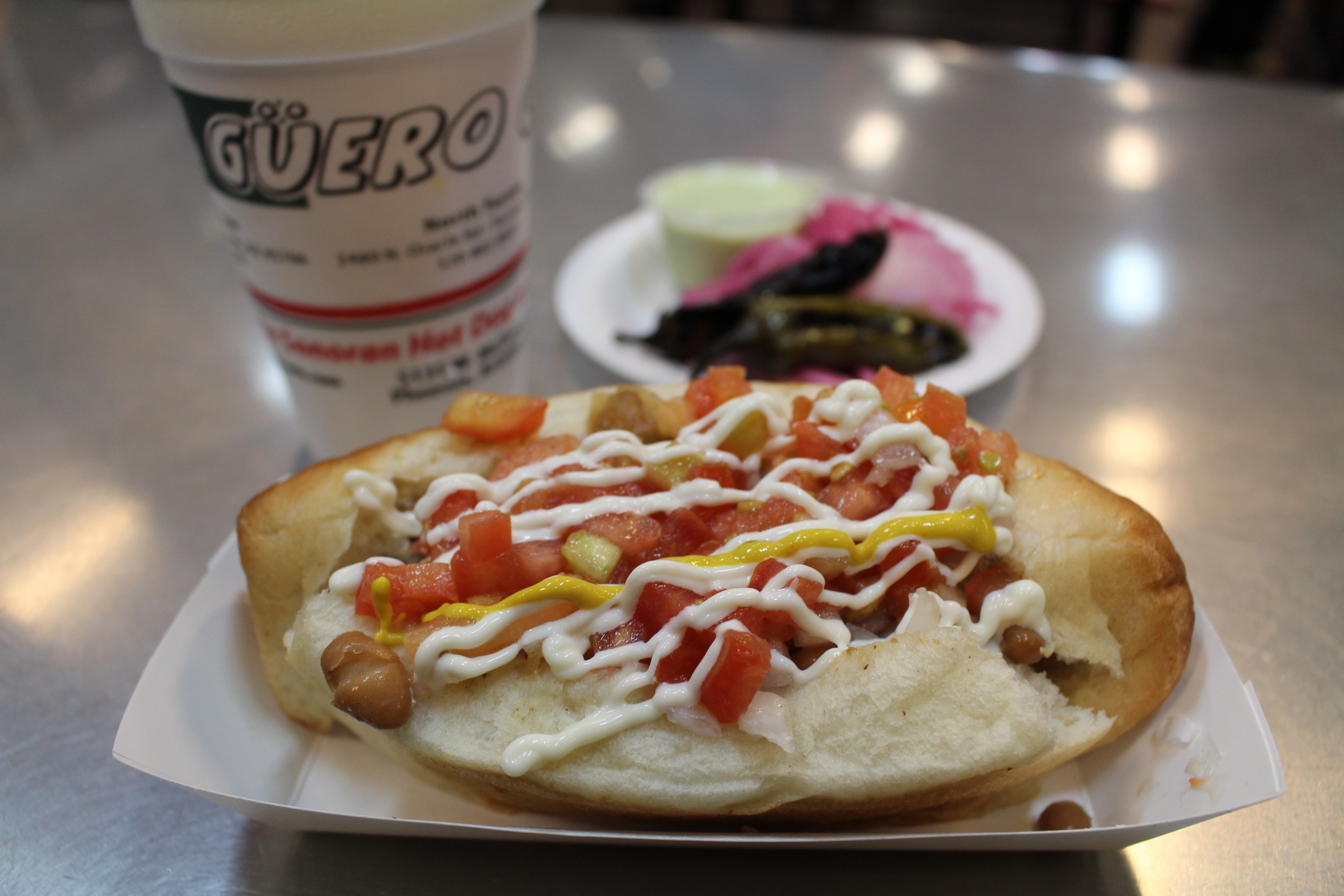
Earlier this month, the James Beard Foundation (JBF) — presenters of the most prestigious food awards in the United States — announced it was anointing El Güero Canelo in Tucson as one of its America’s Classics. This distinction is its version of the Hall of Fame, and goes to restaurants older than 10 years that, as the Foundation notes on its website, are “distinguished by their timeless appeal [and] serve quality food that reflects the character of their communities.”
El Güero is most famous for its Sonoran dogs — what the rest of the country calls bacon-wrapped hot dogs, and which are now a staple at any sporting event or Latino festival across the American Southwest. “The Sonoran hot dog evinces the flow of culinary and cultural influences from the U.S. to Mexico and back,” the Foundation wrote, describing El Güero Canelo's star dish as such: “bacon-wrapped franks, stuffed into stubby bollilos, smothered with beans, onion, mustard, jalapeno [sic] sauce, and a squiggle of mayonnaise.”
The victory was significant for a couple of reasons. El Güero becomes just the third-ever Arizona restaurant deemed an America's Classic, and is one of the few Mexican spots ever bestowed with the title (the pioneering Oaxacan eatery Guelaguetza in Los Angeles is another). But as the JBF’s blurb hinted, it’s also a win for cuisine without borders — and Los Angeles has played a big role in the bacon-wrapped hot dog’s rise.
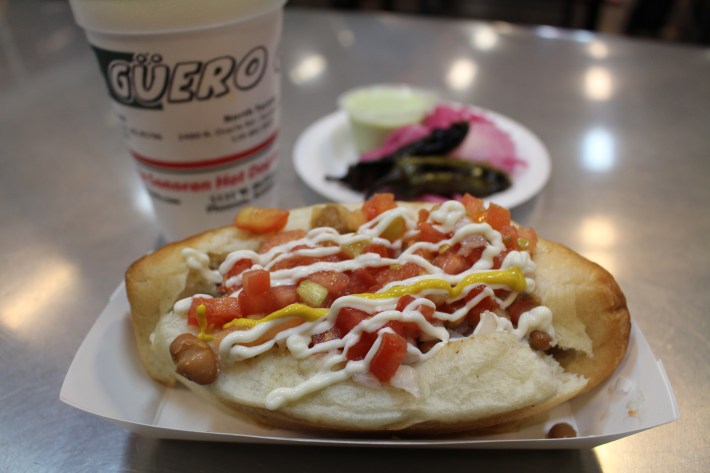
The meal is not a Mexican invention—Oscar Mayer advertised pre-made wieners as early as the 1950s. Around that time, though, restaurateurs in Hermosillo, Sonora, began selling them. Migrants took the hot dogs with them to Tucson, the main port of entry in the United States for sonorenses.
They were first mentioned in the American media in a July 19, 2000 article by longtime Arizona Daily Star columnist Neto Portillo, Jr. His dispatch focused on a friendship lost between the two titans of Sonoran dogs in Tucson: Daniel Contreras of El Güero Canelo, and Benjamin Galaz, owner of BK Tacos (then called BK's Carne Asada and Hot Dogs), both who began their businesses in the early 1990s. Interestingly, Portillo wrote that “Galaz [first] sold Sonoran-style hot dogs" while Contreras specialized in "carne asada tacos.”
Bacon-wrapped hot dogs were already so ubiquitous that the paper didn’t feel the need to elaborate on them.
A 2015 NBC News story on the Sonora dog phenomenon wondered “whether [they would] spread to other parts of the country.” But even by the time of Portillo's column, Mexican-style bacon-wrapped hot dog were already an established part of Southern California life. As I describe in my 2012 book Taco USA: How Mexican Food Conquered America, Sonorans also took their hot dogs to their other major migration point: Tijuana.
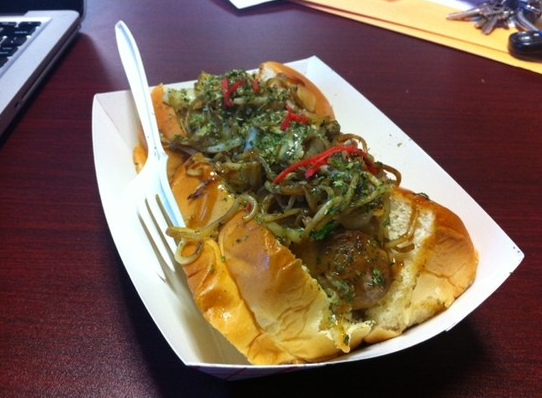
From here, Mexican immigrants took those hot dogs across the U.S. Mexican border and into Los Angeles. In Southern California, the Sonora dog changed. Vendors ditched bolillos in favor of giant hot dog buns, switched out regular franks with any type of gigantic sausage (think: kielbasa, Cajun hot link, Italian, even chorizo), and expanded the toppings beyond Tucson's pinto beans, crema, and tomatoes to anything you can sauté. By the late 1990s, dogueros were already a familiar presence at weekend soccer and baseball leagues across Southern California, but especially at late-night events. Armies of men and women would set up portable grills and sell like crazy to the hungry and curious and drunk. “I probably saw my first one while I was trying to pick up 18-year-old girls at Florentine Gardens,” noted food blogger Eddie Lin told LA Weekly in 2008.
The earliest documented reference to Mexican-style bacon-wrapped hot dogs in the Southern California press came in a 2000 Los Angeles Times story about a Fiestas Patrias festival in Santa Ana.
For the next couple of years, the Times mentioned the hot-dogs more than any other publication, yet always in passing. Bacon-wrapped hot dogs were already so ubiquitous that the paper didn’t feel the need to elaborate on them. And while no one ever called them Sonoran dogs, they earned many more nicknames: Street dogs. Danger dogs. Ghetto dogs. Border dogs. My favorite: the vestigial TJ dogs.
By comparison, the Arizona press only mentioned Sonoran dogs during that time in the context of El Güero Canelo or BK. And when the national media, in the form of newspapers, magazines, and television shows on the Food Network and Travel Channel, finally paid attention, they never bothered to make the Los Angeles connection.
The Sonoran dog is a fluffy thing of beauty, and El Güero Canelo deserves its award.
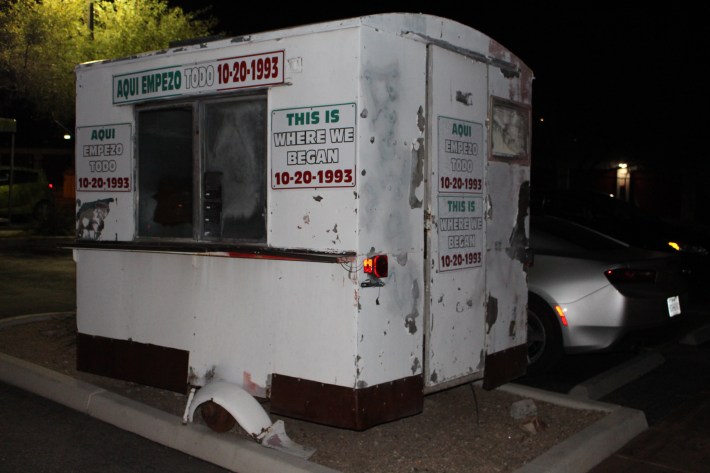
I love the flagship location off Oracle Road because it's as large as an airplane hangar and the cart where Contreras originally started his business is chained to a tree in the parking light, a spotlight on it throughout the night as if it were the American flag.
But the original Sonora dog never evolved past its humble form, and never ventured in the United States outside of Arizona; to this day, you have to visit Tucson and Phoenix to indulge in one. Meanwhile, SoCal's bacon-wrapped hot dog has traveled up Interstate 5 and across I-40, I-15, and I-10 for the past 15 years and spread the meal's gospel. I've seen its migration myself: I remember visiting San Francisco in 2009, and having a friend tell me The City had just been introduced to bacon-wrapped hot dogs.
Together, both the L.A. and Sonoran dog have shown consumers that something as seemingly, obviously American is better when it becomes Mexican food. And L.A.'s take is also further proof of Mexican food's eternal mutability to its surroundings — and its slow, steady conquest of all palates.
Nowadays, bacon-wrapped hot dogs are just getting popular in Houston, and haven't really reached the South yet. But, like Mexicans, they will eventually land wherever Americans desire Mexican food—which is to say, everywhere and anywhere.
*All photos courtesy of the author