[dropcap size=big]S[/dropcap]ome local police departments are acting like your grandparents accepting any old Facebook friend request, by giving out your license plate data to almost anyone that asks – including ICE, the Department of Homeland Security, and even the IRS.
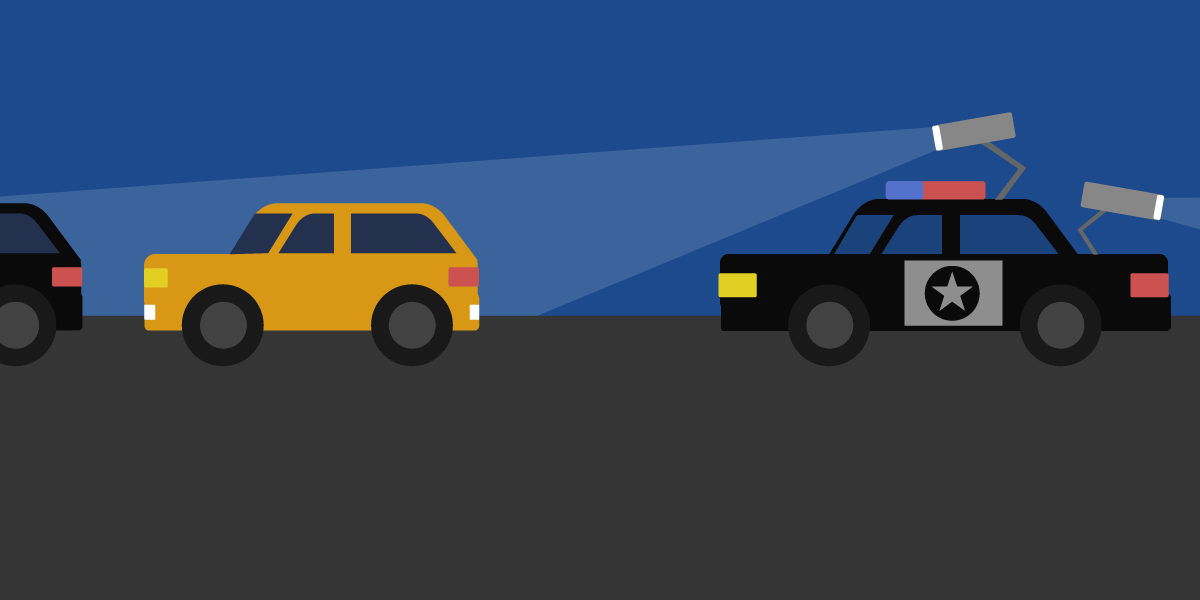
Automated License Plate Readers, or ALPRs, are cameras that can be placed on top of cop cars and light poles, and are used to photograph and record licenses plates, dates, and locations of vehicles. Cops can slap one of these bad boys on their patrol car, cruise around, and import the time and locations of thousands of license plates.
All of this information is sent to a database and stored by police departments across the nation. This unnerving practice becomes Orwellian when these law enforcement departments share this information with hundreds of other entities, many that are tiny or nowhere near you.
For starters, the Los Angeles County Sheriff's department shares data with 21 entities including nearby police departments, like Bell, and the Northern California Regional Intelligence Center (NCRIC).
Bell Police Department shares its ALPR data with a whopping 298 entities, mostly police departments across the country, including weird ones like the City of White in Georgia, who only had two cops on payroll — both of whom were arrested on charges of extortion and false imprisonment in 2016.
It gets worse.
EFF made this visualization of how license plate readers collected data in Oakland.
[dropcap size=big]T[/dropcap]he advocacy group Electronic Frontier Foundation recently found that the welfare fraud investigators working in the Sacramento Department of Human Assistance used ALPR data to surveil welfare recipients. They did so without policies that would be “consistent with respect for individuals’ privacy and civil liberties” according to California state law, EFF said.
As for ICE, while police departments can’t upload all of their license plate data and funnel to ICE or DHS, one of their agents could potentially walk into a police department and ask to run license plates, said Dave Maass, senior investigative researcher at EFF, in an interview with L.A. Taco.
An agent could make an account within a department’s license plate database program and run searches on license plates.
This is exactly what happened in Long Beach. According to documents given to L.A. Taco, in one case, two CBP officers and one ICE officer were allowed to access the Long Beach police department’s license plate database program and ran nearly 1,000 searches.
Like Facebook, departments can share data with approved 'friends' across the nation.
Vigilant Solutions is one of the largest contractors providing police with the tools to collect and share license plate information. It’s basically like Facebook for law enforcement, except instead of storing embarrassing pictures from your high school years, it stores a ton of data on license plates.
Like Facebook, departments can share data with approved (or “friended”) law enforcement agencies across the nation.
The list is astonishing. One document seen by L.A. Taco shows just a sample of the agencies that share your data with one another — police departments in West Covina, San Bernardino, Las Vegas, Orange, San Rafael, Chula Vista, Sacramento, Union City, and on and on.
Maass says to think about your grandparents’ Facebook habits; just as how grandmas tend to accept every friend request, some police departments tend to approve every share requests.
Unusual or teensy agencies also abound: UC Irvine police, Jasper County Sheriff in Missouri, the port of Long Beach police, the Guadalupe County Constables, the Cal State Fullerton police, Yolo County Sheriff, etc.
Maass said he's seen no evidence to suggest that Vigilant Solutions is financially compensating cops for capturing and sharing data, other than perhaps the promise of catching criminals with huge swaths of other people's info. Vigilant Solutions does, however, pay tow trucks to collect data as they move about town.
RELATED: Bell Police Department Data Sharing Report
So who stands to be the most affected by license plate surveillance? “Neighborhoods that have been historically over-policed are now the same neighborhoods that are over surveilled,” the investigator said.
Basically, cops collect the data from communities they’re in the most. So if cops are constantly on one street, they could be collecting data from everyone on that street, if they are equipped with ALPR cameras. More cops, more cameras means that communities of color are disproportionately surveilled.
Is it fair for the police to be tracking almost everyone’s daily travel routine in order to maybe locate a few criminals? What happens if this very private information is hacked? And why is the Bell Police Department sharing their data with the sketchy White Police Department in Georgia?
RELATED: How Police Broke Down the Occupy ICE Encampment in Downtown L.A.