Welcome to Taco de Sonido, our monthly music column presented by Tecate, the official beer of L.A. TACO. Each month we’ll bring you the latest up-and-coming artists that are staking a claim to the new sound of Los Ángeles. Read, listen, share, and don’t be afraid to share your comments or suggestions for new artists for us to check out. We’ve got our ears on the street but we want to hear from YOU.
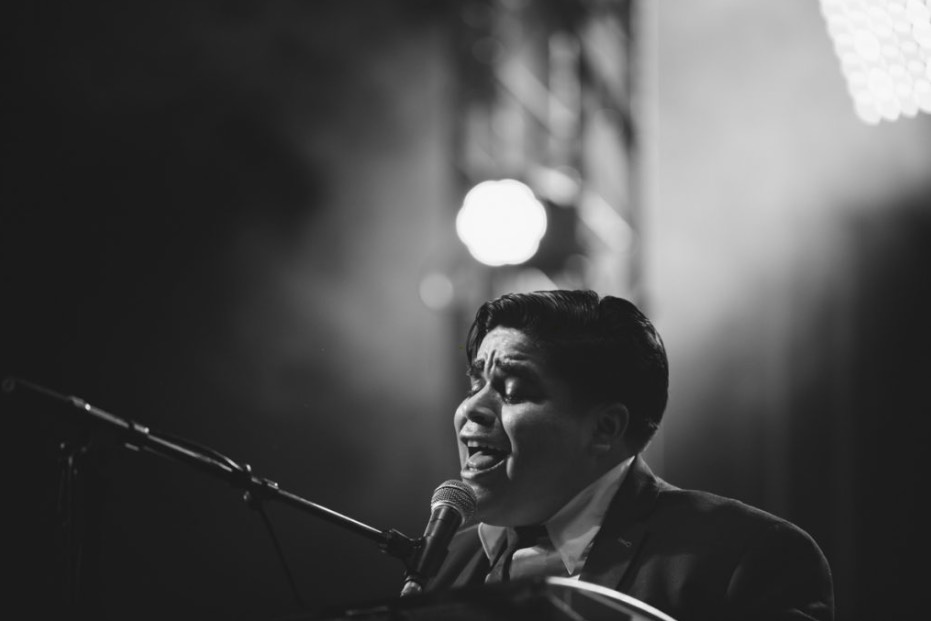
[dropcap size=big]T[/dropcap]he voice of Joey Quiñones shouldn’t exist in our time.
When the East L.A. native voice hits certain notes, it tends to occupy a space somewhere between an artful croon and what could be described as a soft-sounding howl with the opening notes of What’s His Name. It is the type of music that conjures up feelings of a warm, tender embrace coupled with the ability to transport you to another time and place entirely.
As the leader of the modern Chicano soul outfit, Thee Sinseers, and releasing a string of singles as a solo artist, Quiñones and his crew have recently been ushering in a new era of modern soul. It is the type of music that shares a genesis with the birth from the soul, and R&B sounds emitted from the classic lowrider cruising down Whittier Boulevard to the sunshine-y vibes of traditional ska and dancehall reggae.
Quiñones got his start playing music while attending Garfield High School, where he tapped into the fabled East L.A. backyard punk scene. He played in the school’s marching band during the day, and at night, his fast music fueled the circle pits of the anxious youth. Diving headfirst, he found himself dabbling in the various sub-genres of punk rock such as hardcore, pop-punk, and ska. A similar type of blueprint may sound familiar to many of us who grew up in Southern California when discovering our own musical language.
Thee Sinseers started almost as by accident. Quiñones, after being asked to record a live video performance, was feeling a bit shy and insecure to do so on his own, called some close friends who he knew could provide him with the backup support he was looking for. The end result was the recording of Seems Like, which quickly went viral with 1.4 million views along with various offers to play live. Watching the video, you wouldn’t suspect that this was one of the band’s first efforts playing together. The band’s fully realized sound exudes the type of classic coolness that you didn’t know could still exist in this day and age. Quiñones’s own presence commands the camera, as he skillfully works the stage, clutching a zaparate handkerchief, swaying to his own hypnotic groove, all the while conjuring notions of a young Chicano Smokey Robinson or James Brown.
“We got really locked into traditional reggae and vintage ska...pretty much Jamaican music from the 1960s and you start digging into what they were listening to and find out they were listening to soul music.”
This, of course, is no coincidence by any stretch, before starting Thee Sinseers, Quiñones cut his teeth with fellow East L.A. musicians as a founding member of the musical group The Delirians. The band came to prominence playing as the more cost-effective local alternative for various traveling ska and dancehall acts that would come through town to play concerts. While acquainting themselves with the interworking of covering that type of music, they found themselves digging deep into their influences. Upon doing so, they discovered the root of the sound actually came from soul music. “We got really locked into traditional reggae and vintage ska...pretty much Jamaican music from the 1960s and you start digging into what they were listening to and find out they were listening to soul music,” says Quiñones.
After the Delirians, Quiñones attracted an international cult following for his high-pitched vocal dexterity being the frontman for the Steady 45s, a band that made a name for themselves in the scene for their highly enjoyable 1960s ska revival. Before this, he united east and west coast ska styles with his short-lived side project, Sammy Kay and the East Los Three.
Armed with that inspiration intel, Quiñones applied his raw talent into the heart center of the traditional sounds, thereby dissecting the musical DNA to further understand what exactly made it tick. Songs such as Billy Stewart’s I Do Love You and Smokey Robison & The Miracles Ooo Baby Baby he cites as serving as the stylistic text for the music he makes today. The process of accumulating that knowledge would also provide him with some serious cred as a producer, which later he would employ when working with other acts such as The Altons and Johny Ruiz and The Escapers to create a type of signature sound.
In the beginning, Quiñones converted his bedroom at his father’s house into a makeshift production space, taking equal parts inspiration from both Jamaica’s Studio One and Motown Records labels. Lining the small space with piled high tape machines and drum sets, along with various other musical instruments and recording equipment that he had to break down every night just to make room for his bed to sleep.
He describes this approach to producing and performing in this vein as a type of communal approach to making music. “Everybody coming together to make the best sound and whoever was around was going to be on the recording. That's how we approach it. Very live and very, very freeform, but at the same time, everybody has their discipline and where they should stay and where their spot is,” describes Quiñones.
In order to achieve that richness of the sound, an ode to the music that inspires him, Quiñones makes it a point to record everything using an analog tape recorder instead of going the digital route. He describes the old fashion recording method as a more simple approach to making music, with musicians forced to be less-picky with trying to nail a musical part instead of creating piles of music. “It was that mentality of..let's get it right here [and] right now. Then build on it and make it the best we can.”
Quiñones feels hesitant to be pinned as the poster child of the [Chicano Soul] genre however still feels a deep-rooted connection to the music that birthed the term.
It wasn’t until sometime later, after he met radio DJ and promoter DJ Cazel who offered him the studio space in an old radio station located in Rialto. Lighting seemed to strike when Quiñones saw the space. To him, it represented the perfect place to expand his operation and vision for this new incarnation of the Chicano Soul sound.
The term Chicano Soul is a term that Quiñones and his peers are still getting used to. The term Chicano these days encompasses various feelings as the extension of the Mexican American identity but at times can feel antiquated given the current cultural climate. When asked about it, Quiñones feels hesitant to be pinned as the poster child of the genre however still feels a deep-rooted connection to the music that birthed the term.
Recalling back to his youth and being forced to attend his father’s car club events, he remembers feeling bored to tears. However, in retrospect, he supposes the possible lasting impact of these sights and sounds had on him with forming a connection to the soul of the music. “It's funny, you end up back to where you started in the first place,” remarks Quiñones.
It is that sense of pride and respect that comes with playing this type of music and representing the history and culture of East L.A.
“It's about the history that we care most about.”